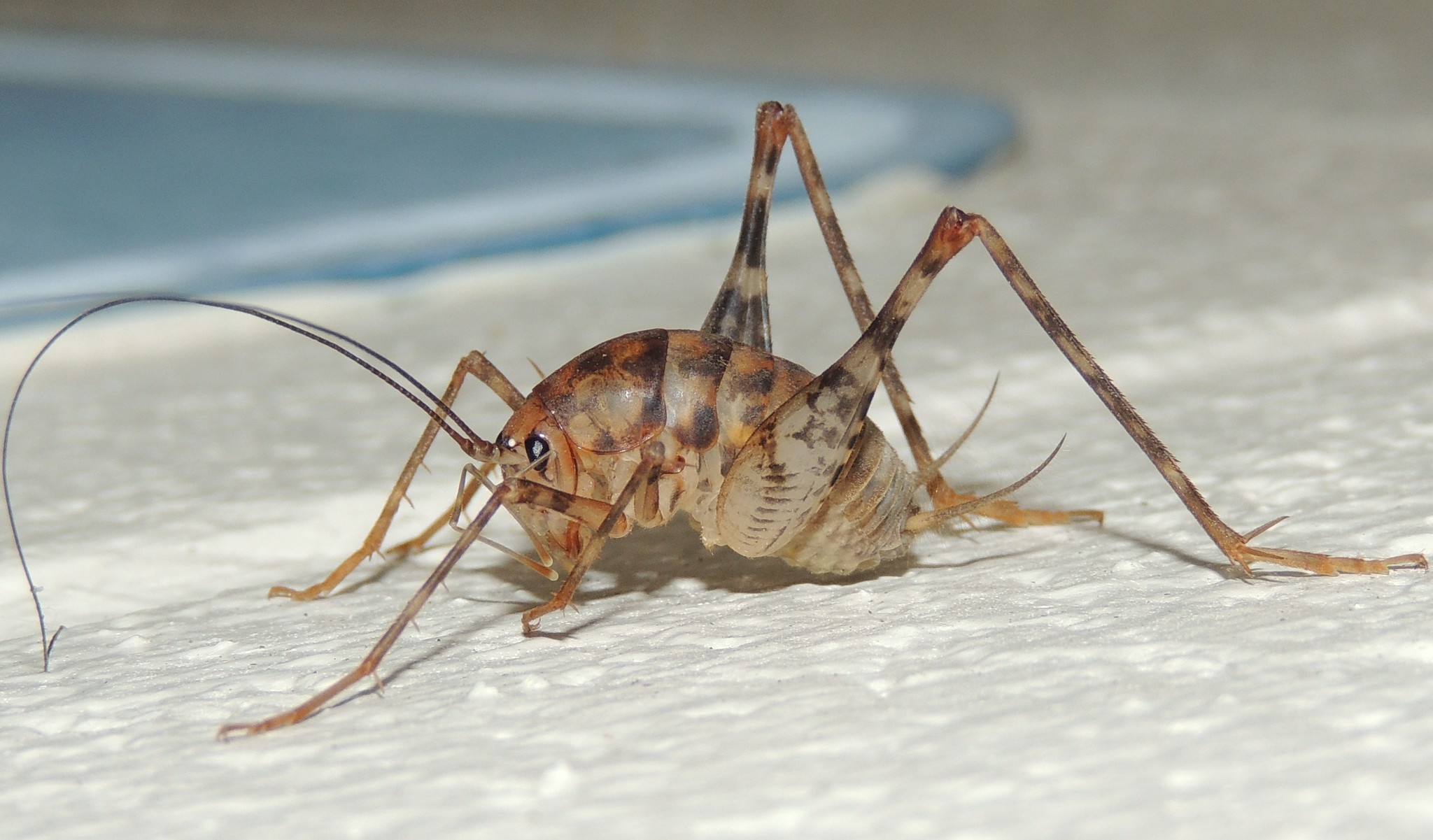
Humpbacked, wingless, and completely silent — camel crickets look alarming but are harmless. They can't bite, chirp, or damage your home. The real fix is reducing moisture and sealing entry points, not chemical treatment.
Moisture ControlExclusionSticky TrapsBasement Pest
🔍Identification & Behavior
🦗
Camel Crickets
Also called cave crickets or spider crickets (Ceuthophilus spp.). Humpbacked, wingless, tan/brown, 13–33mm. Extremely long antennae and large, powerful jumping hind legs. Completely silent — no chirping whatsoever. Often mistaken for spiders due to crouching posture.
🏠
Preferred Habitat
Basements, crawl spaces, garages, utility rooms, and any cool, damp, dark area. Naturally found in caves, under logs, and in leaf litter. Migrate indoors when exterior conditions dry out or temperatures drop. Most active at night.
✅
Harmless — No Risk
Camel crickets do not bite, sting, chirp, or carry disease. They cause no structural damage. They're actually beneficial — they eat organic debris, fungi, and decaying plant matter. The primary issue is their alarming appearance, which generates many service calls.
🔊
vs. House Crickets
House crickets (Acheta domesticus) are light brown, have wings, and chirp loudly. Camel crickets are wingless, humpbacked, and completely silent. The distinction matters — house crickets may need different management. If you hear chirping, it's not a camel cricket.
📋IPM Action Steps
1
Identify the Species
Confirm camel crickets vs. house crickets. Camel crickets: wingless, humpbacked, silent, long antennae, powerful jumping legs. House crickets: winged, flatter body, chirp loudly. This distinction determines whether treatment is even needed.
2
Assess Moisture & Entry Points
Use a hygrometer to measure basement/crawl space humidity. Check for standing water, condensation on pipes, foundation cracks, gaps around basement windows, and utility penetrations. Camel crickets require high humidity — if it's above 60%, that's your primary target.
3
Dehumidify
Run a dehumidifier continuously in the basement or crawl space. Target below 50% relative humidity. This single step eliminates the conditions camel crickets require. Install a hygrometer to monitor progress — most clients see a dramatic decline within 2–3 weeks.
4
Deploy Sticky Traps
Place non-toxic glue traps in basement corners, along walls, behind water heaters, and near floor drains. Check every few days. Traps serve dual purpose: population monitoring and direct capture. Map where you're catching the most to identify entry points and hot spots.
5
Seal Entry Points
Caulk foundation cracks, gaps around basement windows, and utility line penetrations (pipes, wires, cables). Install door sweeps on exterior basement doors. Screen basement window wells. Most camel crickets enter from crawl spaces and the exterior foundation line.
6
Apply DE & Botanical Spray
Dust food-grade diatomaceous earth in cracks, behind utility boxes, and along the sill plate. Apply botanical perimeter spray (peppermint oil) at exterior entry points. Keep DE dry — it loses effectiveness when wet. These are supplemental to moisture control, not substitutes.
7
Reduce Harborage
Remove cardboard boxes, newspaper piles, and clutter from the basement — these hold moisture and provide hiding spots. Clear leaf litter, mulch, and debris from the foundation perimeter outdoors. Store items off the floor on shelving or in sealed plastic bins.
🛠️Prevention & Cultural Controls
💧
Dehumidification
The #1 fix. Run a 50-pint dehumidifier in the basement continuously. Target <50% RH. Install a crawl space vapor barrier if applicable. Fix any plumbing leaks and ensure dryer vents exhaust outside, not into the crawl space.
🌬️
Ventilation & Drainage
Ensure gutters direct water away from the foundation — minimum 4 feet. Grade soil to slope away from the house. Ventilate crawl spaces properly. Use bathroom exhaust fans during and after showers to reduce overall home humidity.
🚪
Exclusion & Habitat
Seal basement windows, utility penetrations, and foundation cracks with silicone caulk. Clear leaf litter and mulch at least 12 inches from the foundation. Remove firewood stacks from against the house. Keep basement free of cardboard and clutter.
⚗️Application Techniques
🪤 Sticky Trap Placement — Monitoring & Capture
Place traps flat along walls in basement corners, behind the water heater, near floor drains, and by sump pits.
Use at least 6–8 traps in a typical basement — more in larger spaces or crawl spaces.
Check traps every 3–5 days. Record catch counts to track population trends.
Replace traps when full or dusty. Declining catches confirm dehumidification is working.
Use a bellows duster to apply a thin, barely-visible film of food-grade DE in cracks along the sill plate, behind utility boxes, and inside wall voids.
Target areas where pipes and wires penetrate walls — these are common entry corridors.
DE must stay dry to work. Do not apply in damp areas or near active leaks — use boric acid for consistently damp locations instead.
Reapply if area gets wet or after any water intrusion event.
Wear a dust mask during application. Keep away from children until settled.
Apply peppermint oil spray (Mighty Mint or equivalent) along the exterior foundation line, around basement window frames, and at utility penetration points.
Spray a continuous band 6–12 inches wide along the foundation perimeter.
Reapply every 5–7 days outdoors, or after rain.
This is a deterrent, not a primary control — moisture reduction and exclusion do the heavy lifting.
🛒Recommended Products
🪤
Catchmaster Sticky Traps
Non-toxic glue traps for monitoring and direct capture. Place flat along walls in basement corners and near moisture sources. Check every 3–5 days. Use catch counts to track population trends and identify entry hot spots.
Non-Toxic / Monitoring
⚗️
Harris Food-Grade Diatomaceous Earth
Food-grade DE with powder duster. Apply thin layers in dry cracks, along the sill plate, behind utility boxes, and in wall voids. Physically damages exoskeletons without chemical toxicity. Must stay dry to be effective.
Food-Grade DE / Mechanical
🌡️
ThermoPro Indoor Hygrometer
Digital humidity monitor for basement and crawl space. Essential for tracking dehumidification progress. Target: below 50% RH. Place at the lowest point of the affected area for the most accurate reading.
Monitoring / Diagnostic
🌿
Mighty Mint Peppermint Oil Spray
Concentrated peppermint oil perimeter spray. Apply along the exterior foundation line and around basement entry points. Pleasant scent, safe for families and pets when dry. Reapply weekly or after rain.
Botanical / Repellent
▶️Training Videos
🪤
Monitoring
Sticky Trap Placement for Basement Pests
Where to place glue traps, how to read catch patterns, and using data to identify entry points and track treatment progress.
Choosing the right dehumidifier, drain hose vs. bucket, ideal placement, target humidity levels, and seasonal adjustments.
Search: Basement Dehumidifier Setup Guide
🚪
Exclusion
Foundation Sealing — Caulk & Weatherstrip Technique
Sealing foundation cracks, basement windows, and utility penetrations. Choosing the right sealant for different gap sizes and materials.
Search: Basement Foundation Sealing Pest Exclusion
⚠️Warnings & Herbal Shield Standards
ℹ️
Purely Nuisance Pest: Camel crickets are harmless — no biting, no disease, no structural damage. If the client is comfortable with occasional sightings, no treatment is required. Always communicate this before recommending services.
🌿
Actually Beneficial: Camel crickets eat organic debris, fungi, and decaying plant matter. They're part of a healthy ecosystem. The goal is exclusion and environmental modification — not extermination.
⚠️
Moisture Is the Real Problem: Camel crickets are an indicator pest — their presence signals a moisture issue. Fixing humidity fixes the cricket problem. Chemical treatment alone will not resolve the issue if the environment remains damp.
🚫
No Synthetic Sprays: Do not use bifenthrin, permethrin, or other synthetic insecticides for camel crickets. The problem is environmental, not chemical. Spraying poisons in a damp basement creates health risks without addressing the root cause. Inconsistent with Herbal Shield's brand promise.
🌿
Food-Grade DE Only: Always use food-grade diatomaceous earth — never pool-grade (calcined) DE, which is hazardous to inhale. DE must stay dry to work. Wear a dust mask during application.
💬
Client Script: "These are cave crickets — they look alarming but they can't bite, chirp, or cause any damage. They're here because your basement has the cool, damp conditions they prefer. If we reduce the humidity and seal the entry points, they'll move on."
💬
Client Script — Why No Spray: "The reason we don't spray for camel crickets is that the problem isn't the crickets themselves — it's the damp environment they need to survive. If we spray and kill the ones you see today, more will come in tomorrow because the conditions are still inviting. When we dehumidify your basement and seal the entry points, the environment no longer supports them. That's a permanent fix, not a temporary one."