← House Centipedes 🖨 Care Card Pantry Moths →
Structural Pest — Field Guide

Carpenter Bees
Xylocopa virginica

Large, solitary bees that bore perfectly round tunnels into bare softwood — decks, fascia, siding, and trim. Learn identification, drilling behavior, wood protection, and deterrent strategies.

Wood-Boring Solitary Bee Structural Damage
🔍Identification & Behavior
Carpenter Bee
Carpenter Bee
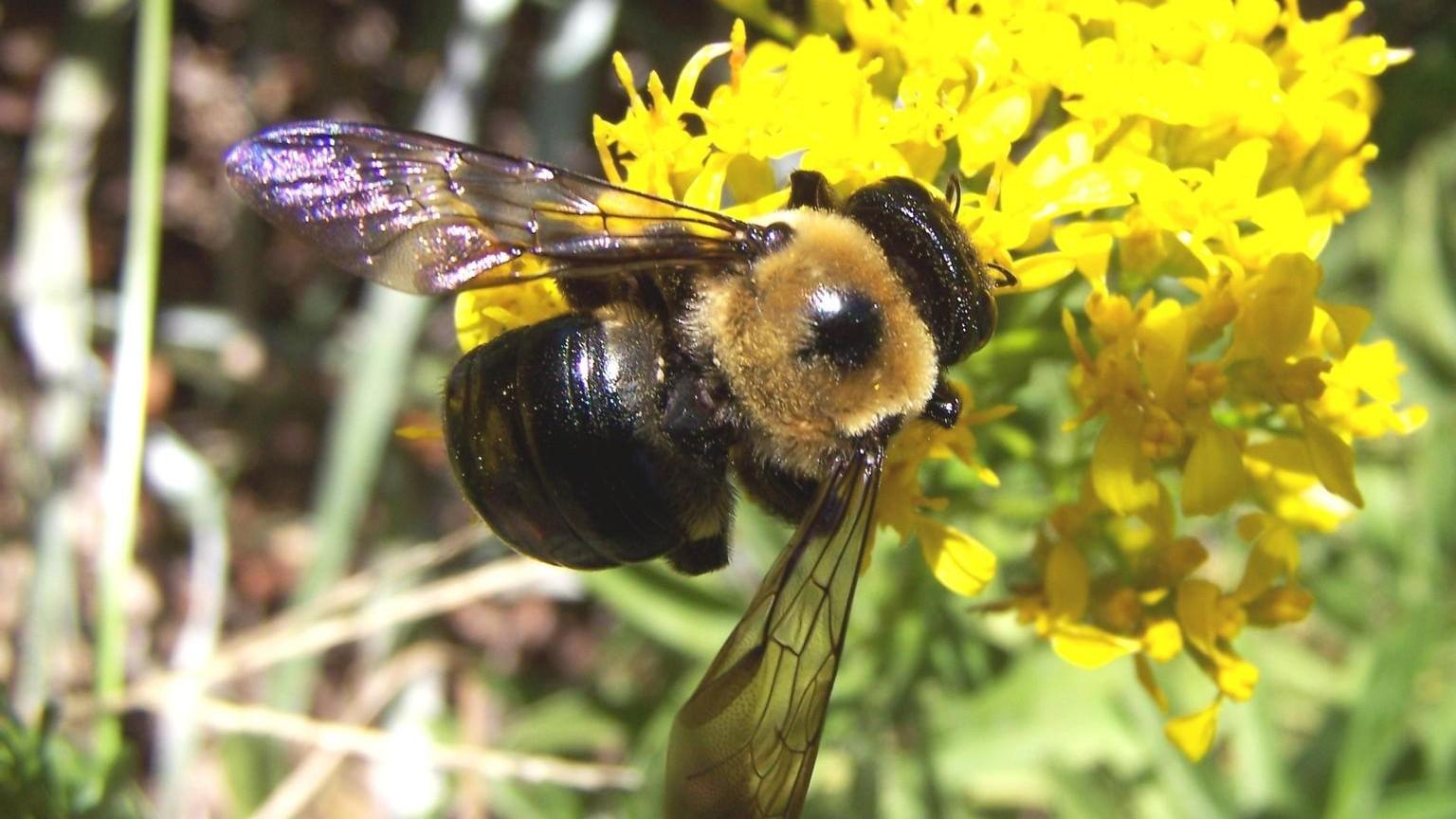
Xylocopa virginica — Eastern Carpenter Bee. Large (¾–1 inch), robust, black and yellow. Key ID: shiny, hairless black abdomen — distinguishes from bumblebees, which have fuzzy yellow abdomens. Males hover aggressively near nests but cannot sting. Females can sting but rarely do.
Bumblebee vs. Carpenter Bee
Carpenter Bee: Shiny black abdomen, solitary, bores round holes in wood, nest entrance has fresh sawdust below.

Bumblebee: Fuzzy yellow abdomen, colonial (50–400 workers), nests underground or in cavities — never bores into wood.
Boring Behavior
Females bore near-perfect ½-inch diameter entrance holes, typically into the underside of wood at a 45° angle, then turn 90° to excavate a gallery running 6–12 inches with the grain. Each gallery takes 6–12 days. Galleries are expanded and reused year after year — a 3-year-old gallery can be 10+ feet long. Boring produces coarse yellow sawdust (frass) below entrance holes — often the first client-visible sign.
Life Cycle & Maryland Seasonality
Spring (April–May): Adults emerge from overwintering galleries. Mating and new boring begin. Peak activity — most complaints received.

Summer (June–Aug): Females provision galleries with pollen balls and lay eggs. Males guard entrance holes.

Late Summer: New adults emerge, feed on nectar, and return to galleries to overwinter.

Year-Round Damage: Woodpeckers excavate galleries searching for larvae — causing secondary structural damage far exceeding the original boring.
Target Wood & Structures
Strong preference for bare, unpainted, weathered softwood. Primary targets in Maryland: pine, cedar, redwood. Common locations: deck railings and joists, fascia boards, soffits, wood siding, porch ceilings, window trim, outdoor furniture. Painted, stained, or pressure-treated wood is strongly avoided — this is the cornerstone of prevention.
Structural Impact
Individual borings cause minimal structural damage. The problem compounds: (1) galleries are reused and expanded annually over decades; (2) water infiltrates bore holes, accelerating rot and weakening wood; (3) woodpeckers aggressively excavate infested boards, sometimes removing entire sections of fascia and siding. A 5-year infestation in a cedar deck can make board replacement necessary.
📋IPM Action Steps
1
Map All Active Entrance Holes
Walk the entire perimeter. Mark every ½-inch entrance hole. Note fresh yellow frass below holes (active) vs. dark staining without fresh frass (old, possibly inactive). Identify primary target species: bare, weathered wood on south and west-facing exposures receives the most boring activity due to sun exposure.
2
Treat Active Galleries at Dusk
Wait until dusk — bees are inside the gallery. Apply boric acid dust or a labeled residual dust (diatomaceous earth works as supplement) directly into the entrance hole using a hand duster. Treat at dusk — bees return to their gallery at nightfall, ensuring maximum contact. Leave holes open for 3–5 days to allow resident bees to move through treated galleries and share product with any others. Do not plug holes yet.
3
Apply Botanical Deterrent Spray
Apply a concentrated citrus oil or peppermint/almond oil spray directly to bare wood surfaces — especially the undersides of boards, railings, and fascia. Reapply every 7–10 days during active season (April–June). While not a standalone treatment, it significantly reduces new boring attempts when combined with sealing and painting.
4
Seal and Fill Galleries
After 3–5 days post-treatment, plug all entrance holes with steel wool packed firmly, then cover with exterior wood filler or caulk. This: (1) prevents remaining bees from exiting and re-establishing; (2) denies new females use of existing galleries in subsequent springs; (3) blocks woodpeckers from accessing larvae. Do not seal holes during the day — bees cannot escape and may bore alternate exits through adjacent wood.
5
Paint or Stain All Bare Wood
This is the single most effective long-term prevention. Carpenter bees strongly avoid painted or stained surfaces. Apply two coats of exterior paint, solid-color stain, or sealant to all previously bare wood. Even clear polyurethane reduces boring significantly. Prioritize: fascia boards, deck railings undersides, window trim, porch ceilings. Recommend scheduling painting with a contractor if the affected area is large.
6
Install Carpenter Bee Traps (Optional Supplemental)
Commercial carpenter bee traps work well as a supplemental tool — especially on decks and porches where painting is not feasible. Install traps in late March (before emergence) near known boring areas. Replace/empty every 4–6 weeks during peak season. Note: traps reduce population pressure but do not eliminate an active infestation alone.
🛠️Prevention & Cultural Controls
🎨
Paint & Seal All Bare Wood
Carpenter bees prefer bare, unpainted softwood — cedar, pine, redwood. Paint, stain, or seal all exterior wood surfaces, including eaves, fascia, window frames, and deck railings. Reapply every 3–5 years. Hardwoods like oak are far less attractive.
🔒
Plug Old Galleries in Fall
Seal old galleries with wood putty or caulk every fall after bees have left for winter. Bees return to the same galleries year after year — eliminating existing holes is the most effective long-term prevention step. Steel wool before caulk prevents re-boring.
🔨
Material Substitution
For high-activity areas, recommend composite or PVC trim over wood — bees cannot bore into these materials. Cedar can be replaced with vinyl soffit and fascia. Treated lumber with pressure-treated or composite decking is a long-term structural fix for repeat-infestation areas.
⚗️Application Techniques
💨 Dust Application into Active Galleries
  1. Treat at dusk (6:30–8 PM, April–September). All resident bees return to their gallery at nightfall.
  2. Use a hand or bellows duster with the nozzle pressed firmly into the entrance hole.
  3. Deliver 2–3 short puffs of boric acid dust or food-grade DE. You want a thin coating on gallery walls, not a piled plug.
  4. Repeat on nights 2 and 3 if frass activity resumes — indicates bees are still active.
  5. Wait 3–5 days before plugging. Female bees inside continue to pass through treated dust during this window.
  6. Wear PPE: dust mask, gloves, eye protection.
🌿 Citrus & Botanical Deterrent — Wood Surface Treatment
  1. Mix concentrated citrus oil (or 50% peppermint/almond oil) with water per label. Apply undiluted to target surfaces for best repellency.
  2. Focus on the undersides of boards, railings, and fascia — carpenter bees prefer to bore from the underside.
  3. Apply with a brush or spray bottle, saturating the wood surface. Allow 30 minutes to penetrate before any rain exposure.
  4. Reapply every 7–10 days during peak season. Rain and UV reduce efficacy quickly on bare wood.
  5. Explain to clients: "This does not kill bees — it makes your wood less attractive to them. Painting is the permanent fix."
🔧 Gallery Plugging — Step-by-Step
  1. Verify no bees are inside gallery (dusk treatment, wait 3–5 days).
  2. Pack gallery opening with steel wool — push in 1–2 inches with a screwdriver or dowel.
  3. Fill remaining space with exterior wood filler, pushing firmly to create a flush surface.
  4. Smooth flush with a putty knife. Allow to cure 24 hours before painting.
  5. Document plugged holes by marking on the inspection sheet — monitor at follow-up visit for any new boring adjacent to sealed holes, which indicates displaced activity.
🛒Recommended Products
💨
Harris Boric Acid Powder
Applied directly into gallery entrances at dusk. Bees contact the dust exiting and entering, carrying it deeper into galleries. Kills resident bees within 1–3 days. Precision tip applicator allows direct gallery injection without spillage.
Boric Acid / Gallery Dust
⚗️
Harris Food-Grade Diatomaceous Earth
Supplemental mechanical kill agent. Apply in combination with boric acid or alone in galleries where boric acid is unavailable. Also effective in void spaces around known boring areas. Food-grade formulation is safe for use near garden areas and bird activity zones.
Food-Grade DE / Mechanical
🍋
Mighty Mint Peppermint Oil / Citrus Oil Spray
Concentrated botanical deterrent spray for bare wood surfaces. Disrupts boring behavior by masking the scent cues that attract females to suitable nest sites. Apply to all exposed, unpainted wood surfaces. Reapply every 7–10 days during peak season April–June. Client-safe and pleasant-smelling.
Botanical / Surface Deterrent
🪤
Carpenter Bee Trap (Wood Box Style)
Cedar or pine box trap with pre-drilled ½-inch entrance holes. Bees enter seeking gallery sites and become trapped in the clear bottle collector below. Effective supplemental tool for decks and porch railings where paint application is not feasible. Install in late March, empty monthly through September.
Mechanical Trap / Supplemental
🎨
Exterior Paint / Solid Stain
The single most effective long-term prevention. Any exterior paint or solid-color stain creates a surface carpenter bees will not bore into. Recommend to clients as the permanent solution. Even a single coat of clear exterior sealant reduces boring significantly compared to bare wood. Document the recommendation in the written treatment plan.
Prevention / Barrier Coating
🔩
Xcluder Fill Fabric + DAP Exterior Filler
Xcluder steel wool mesh packed into gallery openings before sealing with DAP exterior wood filler. The steel wool prevents bees from boring back through the filler plug. Durable, weather-resistant seal that also blocks woodpecker excavation access to treated galleries.
Exclusion / Gallery Seal
▶️Training Videos
Identifying Carpenter Bee Damage
How to distinguish fresh vs. old bore holes, read frass evidence, and assess woodpecker secondary damage. Learn the client walk-around inspection script for carpenter bee visits.
Coming Soon
Dusk Treatment & Gallery Plugging
Step-by-step dusk dust application into active galleries. Correct plugging technique with steel wool and exterior filler. How to document treated holes and schedule follow-up confirmation.
Coming Soon
Client Consultation — Bees vs. Stinging Insects
How to address client fear of bees. Scripts for explaining that male carpenter bees cannot sting, ecological importance of native bees, and why painting is the best long-term solution — without dismissing the client's concern.
Coming Soon
Prevention — Painting & Wood Protection
Walking clients through the painting recommendation: which surfaces to prioritize, product recommendations, and how to frame the investment. Includes the follow-up sales script for converting one-time bee treatments to annual exterior wood inspections.
Coming Soon
⚠️Warnings & Herbal Shield Standards
🚫
Do Not Treat Flowering Plants or Gardens: Carpenter bees are native pollinators. All applications must be targeted precisely to bore holes and bare wood surfaces only. Never apply sprays or dusts near flowering plants, vegetable gardens, or water features. Document this precaution in every treatment report.
🐦
Woodpecker Secondary Damage is Often Worse Than Boring: Always inspect for woodpecker activity (elongated irregular holes, horizontal lines of excavation) when assessing carpenter bee infestations. Woodpeckers can destroy entire sections of siding and fascia in a single season targeting bee larvae. Recommend prompt gallery sealing to prevent woodpecker escalation.
🧤
PPE Required for Dust Applications: Always wear N95 dust mask, gloves, and eye protection when applying boric acid or DE dusts into gallery entrances. Work upwind when possible. Treat at dusk only — never treat active entrances during daylight hours when bees are exiting actively, to avoid defensive behavior from females.
💬
Client Script: "Carpenter bees don't eat your wood — they nest in it. The good news is that the males hovering around you cannot sting. Our approach is to treat the active galleries, seal them so they can't be reused, and put a deterrent on the bare wood. The permanent fix is painting or staining that wood, which bees will completely avoid. We're going to walk you through which areas need attention."