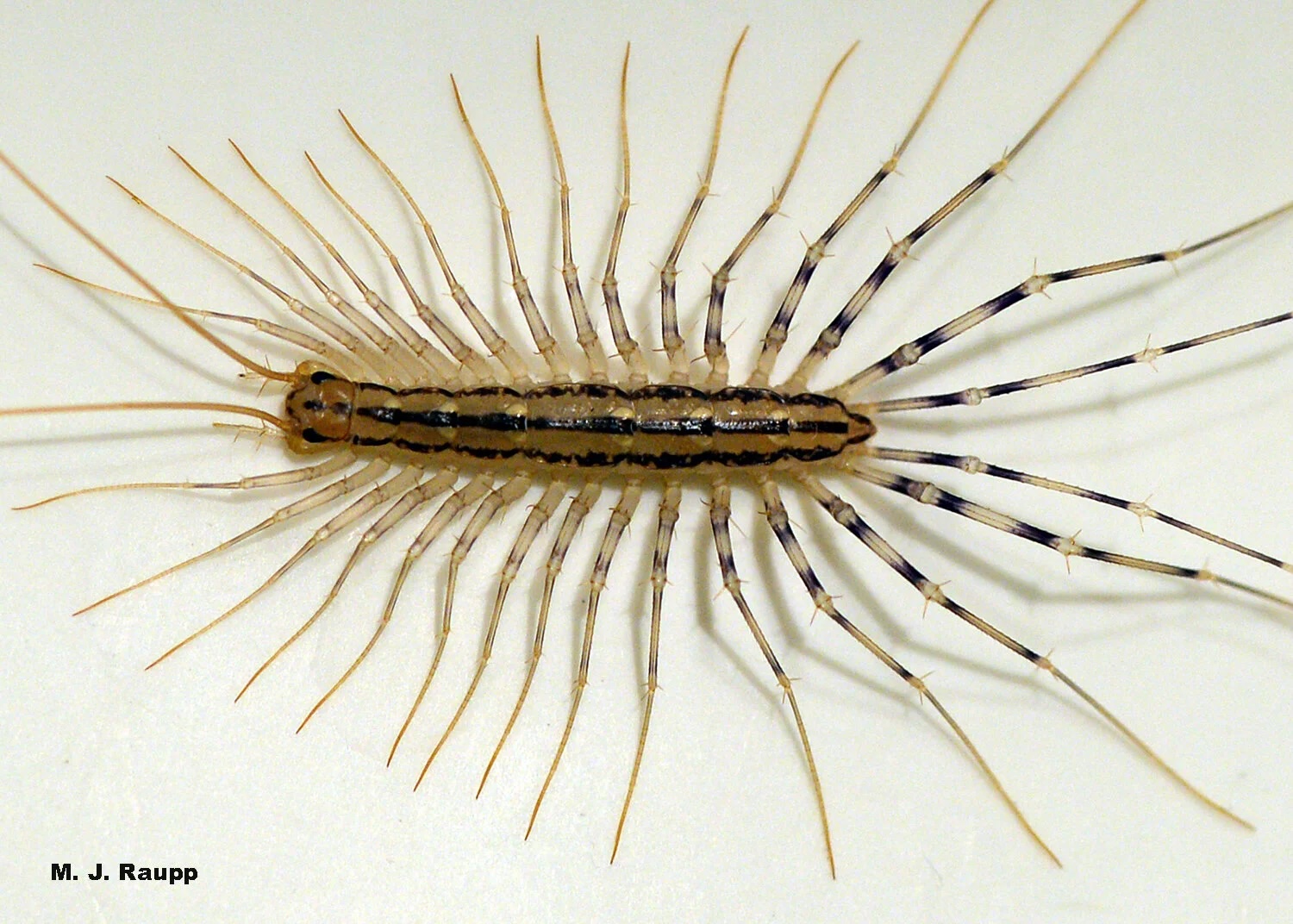
House Centipede — The Indoor Species
Scutigera coleoptrata is the centipede clients will call about. Adults reach 1–1½ inches in body length, but with their 15 pairs of extraordinarily long, banded legs they appear much larger — up to 3–4 inches across. Body color is yellowish-grey to tan with three dark dorsal stripes running lengthwise. Legs are banded in alternating light and dark. The last pair of legs (in females) are nearly twice the body length, easily mistaken for antennae. Two long antennae extend from the head. Movement is extremely fast — darting bursts of speed that startle most people.
Not to confuse with: Millipedes are slower, cylindrical (not flat), with two leg pairs per segment versus one, and do not bite. Stone centipedes (Lithobius spp.) are outdoor/soil dwellers, shorter and stockier — rarely found indoors.
Beneficial Status — Why They Matter
The house centipede is an active predator of common household pests. Its prey list includes cockroaches, silverfish, firebrats, carpet beetle larvae, flies, moths, spiders, termite swarmers, and bed bugs. They use venomous forcipules (modified front legs that deliver venom) to subdue prey — highly effective but essentially harmless to humans.
IPM framing: A centipede in the basement is evidence of other prey insects. Eliminating the centipede without addressing the prey population treats the symptom, not the cause. The Herbal Shield approach always explains this to clients: centipedes are a moisture and prey indicator, not a primary problem. Controlling their prey and moisture removes them naturally.
Bite Risk — Facts vs. Fear
Can they bite? Yes, but it is rare and requires deliberate provocation (picking one up, pressing against skin). Most reported "bites" are from the legs scratching skin, not a true venom injection.
Is it dangerous? No. The venom of Scutigera coleoptrata is not medically significant to healthy humans. The reaction resembles a minor bee sting — localized redness, brief pain, swelling that resolves within hours. No systemic toxicity has been documented. Note: individuals with bee sting allergies may have heightened sensitivity — advise clients to contact a physician if symptoms escalate beyond minor local irritation.
Jaw strength: Smaller centipedes often cannot pierce adult human skin at all. The jaws of Scutigera are weak relative to larger southern species.
Why Are They Here? — Root Causes
Centipedes require three things: moisture, prey, and harborage. They cannot survive in dry conditions — they breathe through spiracles and desiccate quickly without humidity. Finding centipedes indoors almost always points to:
1. Moisture problem — leaking pipes, high basement/crawl-space humidity, condensation, blocked gutters keeping foundation wet, window well moisture accumulation.
2. Prey population — an existing infestation of silverfish, cockroaches, flies, or other insects that sustains the centipede population.
3. Entry points — gaps at foundation, utility penetrations, basement window frames, crawl-space vents without screens.
Centipedes do not infest in the traditional sense — populations remain modest because they are territorial predators. Large numbers indicate a serious moisture or prey problem worth investigating.
Life Cycle & Seasonality in Maryland
Eggs: Females lay 35–150 eggs in soil or moist protected areas in spring and early summer. Some species guard eggs actively.
Juveniles: Hatch with 4 pairs of legs, adding segments and leg pairs with each molt. Development to adult takes 3 years.
Adults: Can live 5–7 years — unusually long for an arthropod. This means once established in ideal conditions, they persist long-term.
Maryland seasonality: Most visible indoors in fall as temperatures drop and centipedes seek warmth. Spring and summer activity peaks outdoors. Basement sightings are year-round in humid homes. Clients often report sudden increases in fall — this is normal seasonal movement, not a new infestation.
Where to Inspect — Priority Zones
Always inspect first: Basement and crawl space (especially near floor drains, sump pits, and along foundation walls), bathroom and kitchen plumbing cabinets, laundry room, window wells, utility/mechanical rooms with condensate drains.
Entry points: Foundation cracks and gaps, where plumbing enters through floors and walls, basement window frames, crawl-space vent screens (torn or missing), garage door thresholds.
Evidence: Centipedes are nocturnal — daytime sightings indicate high population density or a disturbed individual. Dead centipedes on sticky traps are useful monitoring evidence. Check sticky traps placed along basement baseboards and in floor drain areas.