← Wasps 🖨 Care Card Spotted Lanternfly →

Field Guide · Herbal Shield

Brown Marmorated Stink Bugs
Halyomorpha halys

Shield-shaped, slow-moving, and maddeningly persistent every fall — stink bugs are an exclusion problem, not a spray problem. Sealing your home before September is worth more than any treatment after they're inside.

ExclusionBotanical RepellentMechanical RemovalFall Invader
🔍Identification & Behavior
🛡️
Brown Marmorated Stink Bug
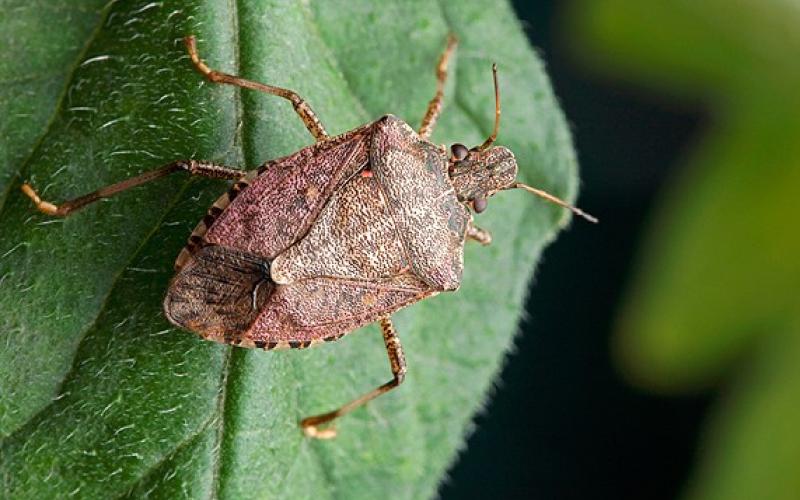
Shield-shaped, mottled brown/gray, approximately 17 mm (~¾"). Key ID features: alternating light-and-dark banding on the antennae and along the exposed edges of the abdomen. Smooth "shoulders" on the thorax (no spines). Underside is pale, off-white. Emits a pungent, cilantro-like odor from thoracic glands when disturbed or crushed.
🔎
Distinguishing from Native Stink Bugs
Several native stink bugs look similar but don't invade homes in large numbers. The brown stink bug (Euschistus servus) lacks the white-banded antennae. The green stink bug is bright green. The spined soldier bug (beneficial — eats garden pests) has pointed "shoulder" spines. Always check the antennae banding — it's the fastest BMSB confirmation.
🏠
Fall Invasion Behavior
Beginning in September as days shorten and temperatures drop, BMSB seek sheltered overwintering sites. They aggregate on sun-warmed south- and west-facing walls in the afternoon, then work into gaps around windows, doors, soffits, and utility penetrations. Once inside wall voids, they enter diapause (dormancy). On warm winter days, they "wake up" and wander into living spaces — the indoor sightings that drive most service calls.
Nuisance Only — No Damage, No Biting
BMSB cannot bite or sting, do not breed indoors, and cause no structural damage. The problems are cosmetic and olfactory: they stain walls and fabrics with a yellowish secretion when crushed, and their defensive odor is deeply unpleasant. They are a significant agricultural pest (fruit and vegetable crops) but strictly a nuisance pest in residential settings.
📋IPM Action Steps
1
Identify the Species
Confirm BMSB by checking for white-banded antennae, smooth shoulders, and the characteristic mottled brown shield shape. Distinguish from native stink bugs and the beneficial spined soldier bug. Collect a specimen in a sealed bag if unsure — do not crush.
2
Set Thresholds
BMSB is purely a nuisance pest indoors. Threshold is tolerance-based: a few stray bugs on warm winter days may not warrant action beyond vacuuming. Consistent daily sightings of 5+ bugs, or clusters forming on exterior walls in fall, warrant a full exclusion response.
3
Exclusion First — Seal Entry Points Before September
This is the single most effective action. Inspect and seal: gaps around windows and door frames, soffit-to-fascia junctions, utility penetrations (pipes, wires, vents), weep holes (screen with mesh, don't plug), attic and crawl space vents (1/16" mesh or finer), chimney flashing gaps, and torn or ill-fitting window screens. Use silicone caulk for fixed gaps, weather stripping for movable joints, and install door sweeps on all exterior doors.
4
Mechanical Removal — Vacuum & Soapy Water
Use a dedicated shop-vac (or insert a knee-high stocking into the hose, secured with a rubber band, to create a removable catch bag). Vacuum live bugs and dispose of the bag in an outdoor trash bin. For small numbers, flick or brush bugs into a jar of soapy water. Never crush — the stain and odor are persistent.
5
Light Traps for Indoor Stragglers
In a dark room, place a desk lamp over a foil roasting pan filled with soapy water. BMSB are attracted to light in dark environments and will fly to the lamp and fall into the water. Run overnight in rooms where bugs are appearing. Commercial LED stink bug traps also work and are less messy.
6
Botanical Repellent at Entry Points
Apply peppermint oil or cedar oil spray at exterior entry points — window frames, door frames, soffit lines, and utility penetrations. This deters bugs from aggregating at those points. Apply in late August before the invasion season begins. Reapply every 5–7 days through October, and after rain. This is a repellent, not a kill — it supplements exclusion, not replaces it.
7
Evaluate & Follow Up
Monitor indoor sightings weekly. If numbers drop after exclusion work, the sealing is holding. If bugs continue appearing in a specific area, re-inspect that wall or window for missed gaps. A thermal camera or smoke pencil can reveal hidden air leaks that bugs exploit. Follow up in mid-October and again in early spring when overwintering bugs become active.
🛠️Prevention & Cultural Controls
🔒
Exclusion — The 90% Solution
Seal every gap larger than ⅛" on the building exterior. Priority targets: window and door frames (silicone caulk), soffit-fascia junctions, ridge vents and gable vents (install fine mesh behind existing screens), utility penetrations for plumbing, electrical, HVAC, and cable (expanding foam + caulk), weep holes in brick (stainless steel mesh inserts — never plug solid), and all torn or loose-fitting window screens. Install door sweeps on every exterior door including garage service doors. This work must be completed by late August to be effective.
💡
Light & Heat Management
BMSB orient toward light and warmth during fall aggregation. Switch exterior lighting near entry points to yellow/amber "bug light" bulbs — they're less attractive than white or blue-toned LEDs. Close blinds and curtains on south- and west-facing windows during afternoon hours in September–November. Interior light leaking through gaps around windows acts as a beacon drawing bugs toward those exact entry points.
🌿
Landscaping & Host Plant Management
Tree-of-heaven (Ailanthus altissima) is the primary BMSB host plant and a powerful attractant. If present on or near the property, removal significantly reduces local BMSB pressure. Other host plants include catalpa, paulownia, and many fruit trees — these don't need removal but should be noted during inspection. Keep vegetation trimmed 12+ inches from the foundation and clear any debris or leaf litter that creates harborage near walls.
⚗️Application Techniques
🌿 Botanical Perimeter Spray — Pre-September Application
  1. Begin applications in late August, before BMSB aggregation starts in earnest.
  2. Spray peppermint oil or cedar oil solution on exterior window frames, door frames, soffit lines, and utility penetrations — the same entry points you've sealed or identified.
  3. Focus on south- and west-facing walls where afternoon sun warms the surface — these are the primary aggregation zones.
  4. Apply a light, even coat — you want the scent barrier, not runoff.
  5. Reapply every 5–7 days through October, and within 24 hours after rain.
  6. This is a repellent only — it discourages aggregation at treated surfaces but will not kill bugs or prevent entry through unsealed gaps.
  7. Shake bottle thoroughly before each use. Test on an inconspicuous area first — some oil formulations can stain light-colored siding or painted trim.
🫙 Soapy Water Jar Traps — Windows & Entry Points
  1. Fill a wide-mouth jar or shallow pan ¾ full with water and add a generous squirt of dish soap (the soap breaks surface tension so bugs sink).
  2. Place traps on windowsills, near light sources, and at known entry points where bugs are appearing indoors.
  3. For active aggregation on exterior walls: hold the jar below clusters and gently brush bugs into the soapy water with a card or soft brush.
  4. Check and empty traps daily. Dispose of contents in outdoor trash.
  5. This is the simplest, cheapest, and most effective removal method for small to moderate numbers.
💡 Light Trap — Dark-Room Method for Indoor Stragglers
  1. Choose a room where stink bugs are frequently appearing. Close all blinds and turn off all lights.
  2. Place a foil roasting pan or shallow baking dish on a table and fill with 2–3 inches of soapy water.
  3. Position a desk lamp directly over the pan, angled so the light reflects off the water surface. A battery-powered LED lantern works equally well.
  4. Leave the trap running overnight. BMSB in the room will orient to the light, land on the lamp or water, and drown.
  5. For a tidier option, commercial stink bug LED traps (Rescue, Catchmaster) use the same principle in a self-contained unit with a collection chamber.
  6. Light traps catch bugs already inside — they do not attract bugs from outside if the room is sealed.
🛒Recommended Products
🌱
Mighty Mint Peppermint Oil Spray
Concentrated peppermint oil in water base. Apply to exterior entry points as a repellent barrier before and during fall aggregation season. Pleasant scent, safe for families and pets once dry. Reapply weekly or after rain.
Botanical / Repellent
🪤
Sticky Window Traps (Catchmaster or Rescue)
Adhesive traps designed for window placement. BMSB walking along window frames and sills get caught on the sticky surface. Low-profile, non-toxic, easy to check and replace. Best used as a monitoring tool and for low-level captures near known entry points.
Monitoring / Mechanical
💡
Rescue SBTR Stink Bug Trap
Commercial LED light trap with collection chamber. Attracts BMSB in darkened rooms using light frequency they're drawn to. Self-contained — no open pans of soapy water. Place in attic, spare bedroom, or basement where bugs overwinter. Empty weekly during active season.
Light Trap / Indoor
🔧
Dedicated Shop-Vac with Stocking Insert
A small shop-vac used only for stink bug removal prevents odor contamination of your household vacuum. Insert a knee-high stocking into the hose (secured with a rubber band) to create a removable catch bag — tie it off and discard in outdoor trash after each use. The most efficient method for large numbers.
Mechanical / Removal
▶️Training Videos
🛡️
Identification
Brown Marmorated Stink Bug — ID & Biology
Identifying BMSB vs. native stink bugs, antenna banding, life cycle stages, and fall aggregation behavior.
Search: Brown Marmorated Stink Bug Identification Guide
🔒
Exclusion
Home Exclusion for Stink Bugs — Sealing Entry Points
Caulking windows, screening vents, door sweeps, soffit repair, and utility penetration sealing to prevent fall invasion.
Search: Stink Bug Home Exclusion Sealing Entry Points
🫙
Trapping
DIY Stink Bug Light Trap — Soapy Water Method
Building and placing the desk-lamp-over-soapy-water trap, catch rates, and best placement for attics and spare rooms.
Search: DIY Stink Bug Light Trap Soapy Water
🌿
Botanical Repellent
Peppermint Oil Perimeter Spray for Fall Invaders
Application technique, timing, coverage area, and realistic expectations for essential oil repellents against stink bugs.
Search: Peppermint Oil Spray Stink Bug Repellent
⚠️Warnings & Herbal Shield Standards
🚫
Never Crush Stink Bugs Indoors: Crushing releases a persistent, foul-smelling secretion that stains walls, fabrics, and carpeting. The yellowish fluid is difficult to clean and the odor lingers. Always vacuum or brush into soapy water instead.
🚫
No Insecticide Foggers or Broadcast Sprays: Bug bombs and indoor sprays do not solve stink bug problems. They kill individual bugs on contact but have zero effect on the hundreds in wall voids, and they contaminate living spaces with unnecessary chemicals. This is fundamentally an exclusion problem — spraying without sealing is wasted effort and inconsistent with Herbal Shield's least-toxic commitment.
⚠️
Botanical Sprays Are Repellent Only: Peppermint and cedar oil deter stink bugs from aggregating at treated surfaces, but they do not create a seal. If gaps exist behind the treated surface, bugs will still find their way in. Always pair botanical sprays with physical exclusion — the spray buys time, but the caulk and mesh do the real work.
💬
Client Script: "Stink bugs are a nuisance pest — they can't bite, sting, or damage your home. The key is sealing entry points before fall. We'll apply a botanical repellent barrier at the main entry zones and help you identify the gaps they're using to get inside. You may still see a few stragglers that were already in the walls before we sealed, but the numbers will drop significantly over the next few weeks. A shop-vac or soapy water jar is the best way to handle any you do see indoors."
💬
Client Script — Why Not Spray: "I know it's tempting to want us to spray, but here's why sealing works better: stink bugs don't eat anything inside your home — they're just sheltering in the walls. A spray might kill the ones you see, but there can be hundreds more in the wall voids where spray can't reach, and new ones keep coming in through the same gaps. When we seal those gaps, we stop the source. The bugs already inside will die naturally over the winter or can be vacuumed up. By next fall, you'll see a dramatic difference."