← Head Lice 🖨 Care Card House Centipedes →
Indoor Fabric & Pantry Pest — Field Guide

Carpet Beetles
Anthrenus & Attagenus spp.

Small, oval beetles whose larvae silently destroy natural-fiber textiles, furs, feathers, and stored pantry goods. Learn to distinguish species, locate hidden infestations, and eliminate them without toxic chemicals.

Fabric Pest Larval Damage Pantry Invader
🔍Identification & Behavior
Carpet Beetle
Three Maryland Species
Black Carpet Beetle (Attagenus unicolor) — uniformly shiny black/dark brown, 3–5 mm, elongated oval. Most common and destructive Maryland species.

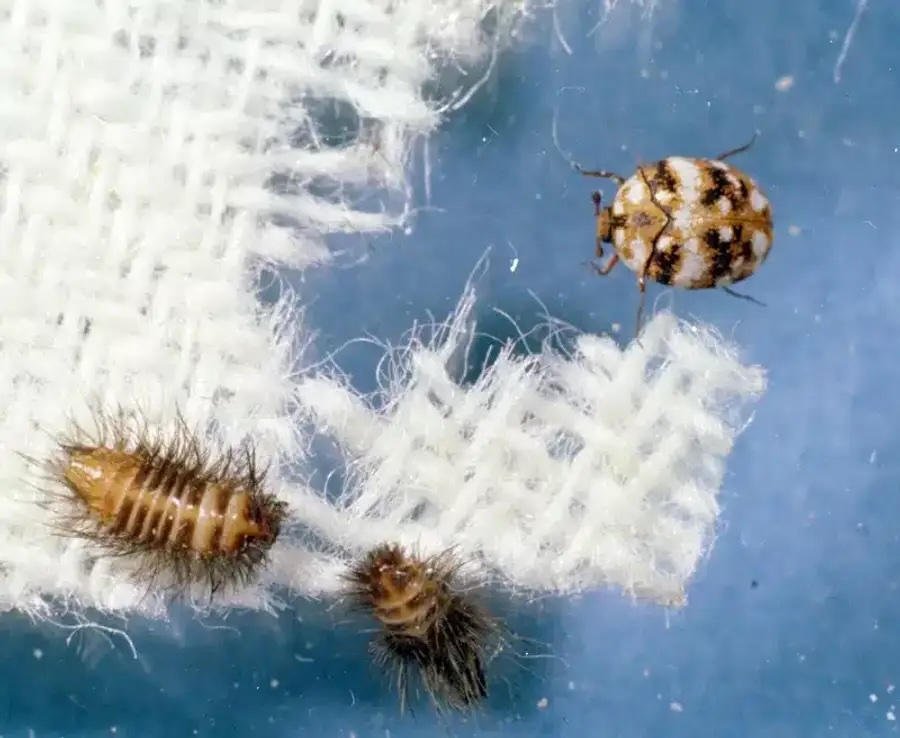
Varied Carpet Beetle (Anthrenus verbasci) — 2–4 mm, rounded, mottled white/yellow/black scales on back. Resembles a tiny ladybug.

Furniture Carpet Beetle (Anthrenus flavipes) — 2–3.5 mm, similar mottled pattern, slightly larger scales. Common in Maryland upholstered furniture.
Larvae — The Real Culprit
Damage is caused entirely by the larval stage, not adults. Larvae are carrot-shaped, 4–8 mm, tan to brown with bands of stiff bristly hairs (hastisetae). Key diagnostic signs:

• Shed larval skins (cast exuviae) — brown, bristly, hollow shells found in dark corners
• Fecal pellets the size of a grain of salt near damage
• Irregular feeding damage on one concentrated area vs. clothes moth scatter holes
• Adults found near windows (they're attracted to light)
What They Eat — Natural Fibers Only
Carpet beetle larvae cannot digest synthetic fibers. Target materials: wool, cashmere, silk, cotton, linen, leather, fur, feathers, down, dried flowers, taxidermy, and natural-bristle brushes. In pantries: cereals, flour, dried pet food, spices, and powdered products. Common hidden locations:

• Under furniture and area rugs at edges
• Inside closets, especially stored seasonal woolens
• In attics and crawlspaces with bird/rodent/bee nests nearby (their natural food source)
• Behind baseboards and in heating duct vents
Life Cycle & Maryland Seasonality
Adults (Spring/Summer): Emerge April–June. Feed on pollen and nectar outdoors — found on flowers near windows. Fly indoors to lay eggs. Adults do not damage fabric.

Eggs: Laid directly on larval food sources — wool carpets, stored clothing, bird nests in eaves. 2-week hatch in warm weather.

Larvae (Year-Round Damage): Feed for 9 months to 3 years depending on food, humidity, and temperature. Slow lifecycle means damage accumulates unnoticed over seasons.

Pupation: Often pupate within the damaged material — cast skins may be the first visible evidence.
Carpet Beetle vs. Clothes Moth
Both destroy natural fibers — but differ in tell-tale signs:

Carpet Beetle: Large irregular patches of damage concentrated in one spot. Brown bristly cast skins. Adults found at windows (light-attracted). No webbing.

Clothes Moth: Scattered small holes throughout a garment. White silky webbing and cocoons in folds. Adults avoid light, flutter away when disturbed.

Treatment approach for both is similar, but this distinction helps clients understand what they're dealing with.
How They Enter Maryland Homes
Carpet beetles are ubiquitous outdoors in Maryland — adults feed on pollen from spring flowers. Entry routes:

• Flying in through open doors/windows during adult flight season (April–June)
• Hitchhiking on cut flowers, firewood, or used furniture
• Arriving with secondhand clothing or estate sale items
• Migrating in from nearby bird, bee, or rodent nests in attic/eaves
• From carpet or furniture stored in moving trucks

A single mated female can lay 50–100 eggs before dying, starting a multi-season infestation.
📋IPM Action Steps
1
Thorough Inspection — Find the Source
The single most important step. Carpet beetle infestations originate from a specific harborage. Inspect methodically: pull furniture away from walls; check rug edges and undersides; open closets and look in dark corners; inspect attic and eaves for bird/bee/rodent nests (a natural food source that sustains colony). Look for cast larval skins and fecal pellets — these persist long after larvae have moved. Map all locations where evidence is found before treating.
2
Remove and Treat the Food Source
Eliminate what the larvae eat. Badly infested items: remove, bag, and dispose of or freeze for 72 hours at 0°F or below (kills all life stages). Dry clean wool and silk items — the heat and solvents kill larvae and eggs. Launder washable natural-fiber items in hot water (120°F+) and dry on high heat for 30+ minutes. Store cleaned seasonal clothing in sealed plastic bins or cedar-lined storage, not cardboard or fabric bags. Remove bird/rodent/bee nests from attic or eaves — these sustain the outdoor population that re-invades.
3
Intensive Vacuuming — Primary Mechanical Control
Vacuum all affected areas thoroughly. Focus on: rug edges and under furniture; baseboards and floor-wall junctions; closet floors and shelving; heating vents and registers. Immediately after vacuuming, remove the vacuum bag or empty the canister outside into a sealed bag and dispose of in an outdoor bin — larvae inside a vacuum bag can survive and re-emerge. Repeat vacuuming weekly for the first month during active infestation treatment.
4
Steam Clean Carpets and Upholstery
Steam cleaning applies heat above 120°F to all life stages of carpet beetles — the most effective mechanical kill method for embedded larvae in carpet pile. Recommend professional steam cleaning for area rugs and upholstered furniture with confirmed larvae. Direct steam treatment of baseboards and floor-wall junctions reaches larvae in cracks where vacuuming can't. One steam treatment after vacuuming, combined with follow-up vacuuming, handles most residential infestations without any chemical treatment.
5
Boric Acid Dust in Cracks and Voids
For persistent infestations where larvae are confirmed in cracks, wall voids, or under baseboards: apply boric acid dust using a hand duster. Target: floor-wall junctions, baseboards, inside wall voids at electrical outlets, and under carpets at tack strips. Boric acid desiccates larvae through physical action — no pesticide resistance possible. Apply lightly — a thin coating is more effective than heavy piling. Keep away from pet and child access areas during application; allow to settle before residents return. Do not apply to open surfaces or food areas.
6
Seal Entry Points and Prevention
Prevent re-entry: caulk gaps around window frames, door frames, and baseboards where beetles enter. Install or repair window screens before adult flight season (April). Periodically rearrange furniture and rugs to expose all floor surfaces to light — carpet beetle larvae prefer dark, undisturbed areas. Move furniture away from walls at least annually for inspection and vacuuming. Advise clients to store all natural-fiber clothing and woolens in sealed containers, not open closets or cardboard boxes.
🛠️Prevention & Cultural Controls
🧹
Vacuuming & Laundering
Vacuum under furniture, along baseboards, and at rug edges weekly — these are larval feeding zones. Wash and dry all woolens, silks, furs, and cashmere before seasonal storage. Dry cleaning also kills all life stages. Never store unwashed items in closets.
📦
Airtight Storage
Store susceptible items (wool, cashmere, silk, leather, feathers) in sealed plastic bins or vacuum-compression bags — not cardboard boxes. Cedar blocks deter adults but do not kill larvae. Avoid museum-quality items near windows where adult beetles enter.
🐦
Remove Nesting Sources
Bird, wasp, and rodent nests inside the building are primary breeding sites — remove them after occupants have left. Check attic spaces and behind shutters in spring. Dead insects in wall voids and light fixtures also sustain populations. Seal attic vents with fine mesh.
⚗️Application Techniques
🧹 Vacuuming Protocol — Sequence and Focus Areas
  1. Before vacuuming, photograph all areas with evidence (cast skins, fecal pellets, damage). This documents the infestation for the client and follow-up comparison.
  2. Start at the perimeter — vacuum all floor-wall junctions, under baseboards, and inside heating vents using a crevice tool.
  3. Vacuum rug edges on all sides, lifting corners to reach the underside. Vacuum carpet pile in both directions to dislodge larvae from within the pile.
  4. Move all furniture and vacuum under each piece thoroughly.
  5. Open closets — vacuum shelving, corners, and the floor. Pay special attention to dark corners where cast skins accumulate.
  6. Immediately bag the vacuum contents, seal the bag, and remove from the home before the end of the visit. Larvae survive in vacuum bags.
  7. Recommend weekly follow-up vacuuming for 30 days after treatment.
💨 Boric Acid Dust Application — Cracks and Voids
  1. Confirm infestation in target area (cast skins, larvae) before applying. Boric acid is a last resort after mechanical controls.
  2. Use a bellows or hand duster with the applicator tip inserted into cracks, floor-wall junctions, and behind baseboards.
  3. Apply a light, thin coating — a visible powder puff indicates over-application. You want a coating on surfaces, not a pile.
  4. Apply inside wall voids at electrical outlet boxes (with power off). Do not apply near open food, food preparation surfaces, or pet bowls.
  5. For carpet edges at tack strips: lift carpet edges carefully and apply dust along tack strip zone before replacing.
  6. Wear N95 mask, gloves, and eye protection. Allow dust to settle 30 minutes before residents re-enter.
  7. Leave boric acid in place — it continues working over weeks to months. Vacuum only the visible open areas; leave dust in cracks undisturbed.
❄️ Cold Treatment — Freezing Infested Items
  1. Seal the infested item in a heavy-duty zip-lock or sealed plastic bag. Squeeze out excess air.
  2. Place in a home freezer set to 0°F or below. A standard home freezer (typically 0°F) works if the temperature holds.
  3. Leave for a minimum of 72 hours (3 days) — this kills all life stages including eggs, larvae, pupae, and adults.
  4. Remove and allow to warm to room temperature before opening bag (prevents condensation damage to items).
  5. Shake or brush out all dead larvae and cast skins before storing the item.
  6. Suitable for: small rugs, wool sweaters, stuffed animals, taxidermy, feather-filled items, old books, dried flowers, spices.
  7. Not suitable for: items that may be damaged by cold (leather, certain dyes, artwork). Steam clean these instead.
🌡️ Cedar Oil / Essential Oil Deterrent Spray
  1. Cedar oil, lavender oil, and clove oil all act as natural repellents against carpet beetle larvae. Most effective as prevention on at-risk stored items.
  2. Mix per label directions (or 10–15 drops essential oil per 1 oz water for a light deterrent) and apply to the inside of storage boxes, cedar blocks, or sachets near stored woolens.
  3. Apply to the interior of closets: spray lightly along shelving and inside corners. Allow to dry before storing clothing.
  4. Do not apply directly to wool or silk — oils can stain. Use sachets or cedar blocks near (not touching) garments.
  5. Reapply to storage areas every 3–4 months. Cedar effectiveness diminishes as the volatile oils evaporate.
  6. Explain to clients: "This is a deterrent for prevention and ongoing storage protection — it does not kill an active infestation."
🛒Recommended Products
💨
Harris Boric Acid Powder
Applied into cracks, floor-wall junctions, and wall voids where larvae are confirmed. Kills larvae by desiccation through physical action — no chemical resistance possible. Use precision tip applicator to target cracks without over-application on open surfaces. Only as a last resort when mechanical controls have not resolved the infestation.
Boric Acid / Crack & Crevice
🫙
Carpet Beetle Sticky Traps (Pheromone)
Pheromone-baited sticky traps capture adult carpet beetles and help locate infestation hotspots. Place along baseboards, inside closets, near rugs, and in attic spaces. Monitor weekly — the trap with the most catch indicates the primary harborage zone. Also useful post-treatment to confirm infestation resolution. Change traps monthly.
Monitoring / Mechanical Trap
🌲
Cedar Blocks / Cedar Oil Spray
Natural volatile oils in cedar repel carpet beetle larvae and clothes moths from stored textiles. Use cedar blocks or cedar-lined storage boxes for seasonal wool, cashmere, and fur storage. Cedar oil spray applied inside closets and storage boxes provides an additional barrier. Refresh every 3–4 months by lightly sanding cedar surfaces or reapplying oil spray. Not a treatment — prevention for stored items only.
Botanical / Storage Deterrent
🧪
Food-Grade Diatomaceous Earth (DE)
Supplemental mechanical desiccant applied to floor-wall junctions and under carpets at edges where boric acid is not appropriate. Food-grade DE is safe near pets and children once settled. Apply sparingly using a bulb duster. Particularly effective in dry conditions — humidity above 50% reduces DE effectiveness significantly.
Food-Grade DE / Mechanical
🎒
Heavy-Duty Zip-Seal Storage Bags (Gallon & 2-Gallon)
Essential for the treatment: sealing infested items for freezer treatment, and for long-term protected storage of treated woolens. Recommend to clients as part of a permanent storage protocol. Vacuum-seal bags for bulky items like comforters and heavy sweaters. Prevention recommendation: seal all natural-fiber clothing stored seasonally — the single most effective long-term prevention measure.
Exclusion / Storage Protocol
💜
Lavender Sachets / Mothballs Alternative
Dried lavender, cloves, and rosemary sachets placed inside storage containers and closets deter carpet beetle adults from laying eggs on stored natural fibers. A safe, non-toxic alternative to synthetic mothballs (which contain naphthalene or paradichlorobenzene — chemicals with serious health and environmental concerns). Replace sachets every 4–6 months as fragrance diminishes.
Botanical / Natural Deterrent
▶️Training Videos
Carpet Beetle
Identifying Carpet Beetle Damage vs. Clothes Moths
Side-by-side comparison of cast skins, fecal pellets, and damage patterns. Inspection walkthrough: where to look in closets, under furniture, and in attic spaces. How to read evidence to determine the primary harborage.
Coming Soon
Carpet Beetle
Vacuuming Protocol & Mechanical Control
Step-by-step vacuuming sequence: crevice tools, rug edge technique, furniture movement. Proper bag disposal to prevent recontamination. Recommending steam cleaning to clients as a complementary treatment.
Coming Soon
Carpet Beetle
Boric Acid Dust Application — When and How
Demonstrating crack-and-crevice boric acid application. What "light application" means in practice. Where not to apply. PPE requirements. How to explain to clients why we use this only as a last resort after mechanical controls.
Coming Soon
Carpet Beetle
Client Consultation — Storage & Long-Term Prevention
How to walk clients through the permanent fix: sealed storage for woolens, cedar blocks, sachets, and annual inspection habits. Script for recommending dry cleaning and professional steam cleaning. Converting one-time carpet beetle service to an annual fabric and textile inspection program.
Coming Soon
⚠️Warnings & Herbal Shield Standards
🚫
Never Recommend Synthetic Mothballs: Clients often ask about mothballs. Traditional mothballs contain naphthalene or 1,4-dichlorobenzene — both are toxic, volatile compounds linked to liver damage, neurological effects, and classified as possible carcinogens. Our standard is: cedar, lavender sachets, or sealed storage containers. Document this in every carpet beetle treatment plan.
🚫
Avoid Synthetic Pyrethroid Sprays: Products containing bifenthrin, permethrin, deltamethrin, or pyrethrins are commonly marketed for carpet beetles but are not consistent with Herbal Shield's brand promise. These chemicals have significant aquatic toxicity, are harmful to bees, and leave residues on fabrics. Beyond Pesticides specifically lists these chemicals to avoid for carpet beetle treatment. Our approach — mechanical removal, heat, cold, boric acid in voids — achieves the same result safely.
⚠️
Boric Acid — Targeted Use Only: Boric acid is our chemical last resort. It must be applied only in cracks, crevices, and wall voids — never on open floor surfaces where pets and children have direct contact. Always communicate clearly with clients about where the product was applied, and when it's safe to vacuum (leave undisturbed in cracks; clean open surfaces 30 minutes after application).
🏠
Heirloom & Valuable Textiles: When clients have antique rugs, inherited woolens, or valuable taxidermy, recommend professional textile conservators or museum-grade storage before treating. Never attempt steam cleaning on antique rugs without confirming dye stability. Freezing is the safest treatment for irreplaceable items — confirm the item is not moisture-sensitive before bagging.
💬
Client Script: "Carpet beetle larvae are what's causing the damage — not the adults you might see near your windows. Our approach starts with removing what they eat and vacuuming thoroughly. For anything stored in closets, sealed containers and cedar blocks will prevent them from coming back. We only use boric acid if we find larvae in cracks that we can't reach mechanically, and only in those out-of-reach spots."