← Stink Bugs 🖨 Care Card Mosquitoes →

Field Guide · Herbal Shield

Spotted Lanternfly
Lycorma delicatula

An invasive, quarantine-regulated pest devastating mid-Atlantic agriculture. Every property owner has a role in slowing its spread — and tree-of-heaven removal is the single most impactful action you can take.

Invasive SpeciesTree-of-HeavenSticky BandsQuarantine Pest
🔍Identification & Behavior
🦋
Adult — July through December
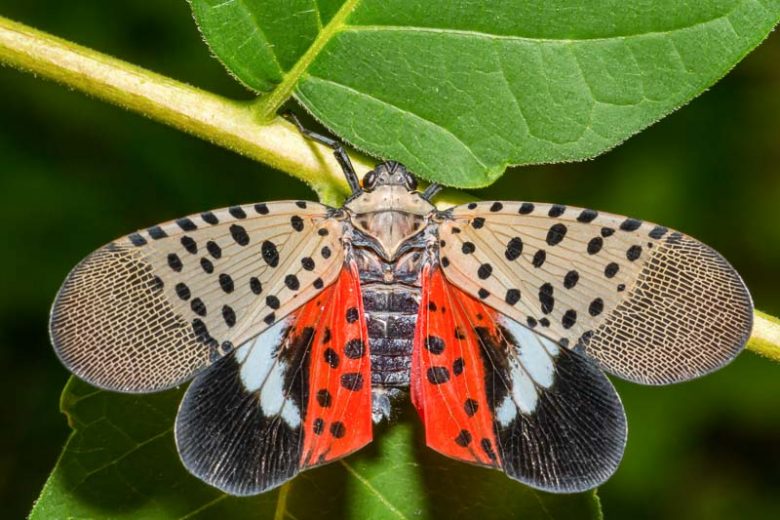
Approximately 1" long with wings folded. Forewings: gray-tan with rows of black spots near the body and a dense black-spotted band at the wingtips. Hindwings (visible in flight or when startled): vivid scarlet-red upper half with black spots, white lower band, and black wingtip. Abdomen is bright yellow with black banding. Strong jumpers — they hop before flying when disturbed. Adults are most visible July–November, with peak activity in September.
🐛
Nymph Stages — April through July
Early nymphs (1st–3rd instar, April–June): small (4–12 mm), black body with bright white spots. Move quickly and cluster on stems and trunks. Late nymphs (4th instar, July): larger (~12 mm), striking red body with white spots and black patches on legs and wing pads. Both stages feed by piercing plant tissue and sucking sap. Nymphs cannot fly but are excellent jumpers and climbers.
🥚
Egg Masses — September through May
Females lay egg masses on almost any smooth outdoor surface: tree trunks, branches, stone walls, vehicles, outdoor furniture, grills, trailers, firewood, and fencing. Fresh masses look like a smear of grayish-brown putty or wet mud (30–50 eggs in rows, covered with a waxy coating). Older masses dry and crack, resembling cracked, gray-brown mud. Each mass contains 30–50 eggs. Laid September–November; eggs overwinter and hatch in May. Egg mass destruction is the #1 residential control.
🌳
Host Plants & Feeding
Primary host: tree-of-heaven (Ailanthus altissima) — the preferred feeding and egg-laying tree, and the key to managing SLF on any property. Other hosts: grapevines (severe damage), maples, black walnut, willow, birch, fruit trees (apple, peach, cherry, plum), hops, and rose. SLF feed on sap and excrete large quantities of sticky "honeydew" that coats surfaces below and promotes black sooty mold growth. Maryland quarantine zones are active — check the MD Dept of Agriculture website for current boundaries.
📋IPM Action Steps
1
Identify the Life Stage
Determine whether you're dealing with egg masses (Oct–May), early nymphs (April–June, black with white spots), late nymphs (July, red with white spots), or adults (July–Dec, spotted gray wings). Your control approach differs by stage. Photograph specimens for confirmation. If you're unfamiliar with SLF, compare to online ID guides — they are quite distinctive at all stages.
2
Report to MD Dept of Agriculture
If you are outside a known quarantine zone and spot SLF, report immediately to the Maryland Department of Agriculture at 1-410-841-5920 or through their online reporting form. Early detection of new populations is critical to containment. Even within quarantine zones, reporting large new aggregations helps the state track spread and allocate resources.
3
Destroy Egg Masses — October through May
Survey all outdoor surfaces systematically: tree trunks (especially tree-of-heaven, maples, and willows), stone and brick walls, fences, outdoor furniture, vehicles, trailers, and firewood stacks. Scrape egg masses into a container of rubbing alcohol or hand sanitizer (a doubled zip-lock bag works well). Do not simply scrape them onto the ground — eggs can still hatch. A putty knife, old credit card, or dedicated scraper works well. This is the most effective residential control action.
4
Install Sticky Bands on Trees — With Wildlife Guards
Wrap sticky bands (wide adhesive tape, sticky side out) around tree trunks at chest height to capture nymphs and adults as they climb to feed. Critical: always cage sticky bands inside a hardware cloth guard (a cylinder of ½" galvanized wire mesh around the band, held off the surface by spacers). Without a guard, birds, squirrels, bats, and other non-target wildlife become trapped on the adhesive. Check bands weekly and replace when saturated. Install April–November.
5
Circle Traps — A Safer Alternative to Sticky Bands
Circle traps (funnel-style traps that wrap around tree trunks) capture SLF in a collection container without exposed adhesive, eliminating wildlife bycatch entirely. Nymphs and adults walk up the trunk, hit the funnel, and are directed into the collection chamber. Commercial circle traps are available, or they can be built from window screen material. This is the preferred method on properties with significant wildlife activity.
6
Neem Oil or Insecticidal Soap on Nymph Aggregations
When nymphs are clustered on trunks and stems (common in May–July), spray aggregations directly with neem oil or insecticidal soap solution. These are contact-kill products — they must hit the nymphs directly to work. Neem also has some repellent and anti-feeding properties. Reapply after rain. Do not spray when pollinators are active on nearby flowering plants. This is supplemental to trapping and egg mass removal, not a standalone solution.
7
Remove Tree-of-Heaven — The Long-Term Solution
Tree-of-heaven (Ailanthus altissima) is the keystone host plant. Removing it from the property — especially female trees (identified by seed clusters in summer) — dramatically reduces SLF feeding, egg-laying, and aggregation pressure. Important: simply cutting tree-of-heaven causes aggressive resprouting from the stump and root system, often making the problem worse. Effective removal requires herbicide application to the cut stump or a hack-and-squirt treatment on the live trunk. This requires a licensed pesticide applicator in Maryland. Herbal Shield can coordinate referral to a licensed arborist for this work.
🛠️Prevention & Cultural Controls
🌳
Tree-of-Heaven Management
This is the single most impactful action for any property. Identify all Ailanthus altissima on and adjacent to the property. Female trees (those producing winged seed clusters June–September) are highest priority. Coordinate professional removal with stump herbicide treatment to prevent resprouting. If full removal isn't feasible, treat remaining trees as "trap trees" — band them heavily to intercept SLF that aggregate there. Never cut tree-of-heaven without stump treatment.
🚗
Vehicle & Equipment Inspection
Before leaving a quarantine zone, inspect vehicles, trailers, outdoor equipment, firewood, and any items stored outdoors for SLF egg masses, nymphs, or adults. Check wheel wells, truck beds, undercarriages, and tarps. Maryland's quarantine means it is illegal to move regulated articles (plants, landscaping materials, outdoor equipment) out of a quarantine zone without inspection. This is the primary way SLF spreads to new areas — hitchhiking on human transport.
🔍
Egg Mass Surveys — October through May
Conduct thorough surveys of your property in late fall and again in early spring. Check every outdoor surface: tree trunks and branches (up as high as you can see), stone walls, fencing, outdoor furniture, play equipment, grills, sheds, vehicles, and any items stored outside. Fresh egg masses are putty-colored and smooth; older masses are dry, gray, and cracked. Scrape and destroy every mass you find — each one contains 30–50 potential nymphs. Two surveys per season (November and March) are recommended.
⚗️Application Techniques
🔪 Egg Mass Scraping — The #1 Residential Control
  1. Prepare a doubled zip-lock bag with 1–2 inches of rubbing alcohol or hand sanitizer in the bottom. This kills the eggs on contact.
  2. Use a putty knife, plastic scraper, or old credit card to scrape the entire mass off the surface in one motion. Scrape firmly — eggs adhere to surfaces and partial scraping leaves viable eggs behind.
  3. Deposit the scraped mass directly into the alcohol/sanitizer bag. Do not drop masses on the ground — eggs can survive and hatch on soil.
  4. Seal the bag. You can continue adding masses to the same bag throughout your survey.
  5. When finished, double-check the scrape sites — go back over any that show residual egg material.
  6. Dispose of the sealed bag in household trash. The alcohol kills all eggs within 24 hours.
  7. Survey systematically: walk the full perimeter of every structure, check all trees trunk-by-trunk, and inspect any outdoor items including vehicles, grills, and furniture.
🪤 Sticky Band Installation — With Mandatory Wildlife Guard
  1. Select target trees — prioritize tree-of-heaven, then maples, willows, and any tree showing heavy SLF activity or honeydew/sooty mold.
  2. Wrap a 6–8 inch wide strip of sticky adhesive band (or wide packing tape, sticky side out) around the trunk at chest height (~4–5 feet). Secure with push pins or staples at the overlap.
  3. Build a wildlife guard: cut a section of ½" galvanized hardware cloth tall enough to cover the sticky band plus 2 inches above and below. Form it into a cylinder around the trunk over the band, leaving 1–2 inches of airspace between the mesh and the sticky surface. Secure with wire ties. This allows SLF to pass through the mesh and contact the adhesive while preventing birds, squirrels, bats, and other wildlife from becoming trapped.
  4. Check bands weekly. Replace when the sticky surface is saturated with captures or debris.
  5. Count captures if possible — this data helps track population trends and informs whether additional control (circle traps, neem spray) is warranted.
  6. Remove bands and guards after the season ends (December).
🌿 Neem Oil Spray — Contact Treatment for Nymph Clusters
  1. Mix neem oil concentrate according to label directions (typically 2 tablespoons per gallon of water with a few drops of dish soap as an emulsifier). Alternatively, use a ready-to-use insecticidal soap spray.
  2. Identify nymph aggregation sites — they cluster on trunks, stems, and the undersides of branches, especially on tree-of-heaven, maples, and grapevines.
  3. Spray directly onto nymph clusters. This is a contact product — it must hit the insects to be effective. Drench the cluster thoroughly.
  4. Spray in early morning or late evening to avoid contact with pollinators on nearby flowering plants.
  5. Reapply after rain or every 7–10 days during active nymph season (May–July).
  6. Neem has supplemental anti-feeding and repellent properties but is not a standalone solution. Always combine with egg mass removal, tree banding, and tree-of-heaven management.
🛒Recommended Products
🪤
Sticky Tree Bands with Hardware Cloth Guard
Wide adhesive bands for wrapping tree trunks to intercept climbing SLF nymphs and adults. Must always be installed inside a ½" hardware cloth cage to protect non-target wildlife. Check and replace weekly during active season (April–November). Most effective on tree-of-heaven and other primary host trees.
Mechanical / Trapping
🌿
Neem Oil Concentrate (Cold-Pressed)
Botanical insecticide derived from neem seeds. Mix with water and a soap emulsifier for a contact spray against SLF nymphs. Also provides anti-feeding and mild repellent effects. Apply directly to nymph clusters on trunks and stems. Safe for use around food-producing plants when label directions are followed. Reapply weekly or after rain.
Botanical / Contact Kill
🔪
Egg Mass Scraping Kit
A rigid plastic scraper or putty knife paired with doubled zip-lock bags and rubbing alcohol. The most effective residential control tool for SLF. Survey and scrape egg masses from all outdoor surfaces October through May. Each mass destroyed eliminates 30–50 potential nymphs.
Mechanical / Egg Removal
🔄
Circle Trap (Funnel-Style Tree Trap)
Wildlife-safe alternative to sticky bands. A screen funnel wraps the trunk and directs climbing SLF into a collection container at the top. No exposed adhesive means zero risk to birds, bats, or squirrels. Commercial versions are available from Penn State Extension or can be DIY-built from window screen material. Preferred for properties with significant wildlife.
Mechanical / Wildlife-Safe
▶️Training Videos
🔴
Identification
Spotted Lanternfly — All Life Stages ID Guide
Identifying SLF adults, early and late nymphs, and egg masses. Distinguishing from similar-looking native insects. What to report and to whom.
Search: Spotted Lanternfly Identification All Life Stages
🔪
Egg Mass Removal
How to Find & Destroy Spotted Lanternfly Egg Masses
Survey technique, scraping method, alcohol bag disposal, and where to look — including surfaces most people miss.
Search: Spotted Lanternfly Egg Mass Removal Tutorial
🪤
Tree Banding
Sticky Bands & Circle Traps for Spotted Lanternfly
Installing sticky bands with wildlife guards, building a hardware cloth cage, and assembling a DIY circle trap from window screen.
Search: Spotted Lanternfly Sticky Band Wildlife Guard Circle Trap
🌳
Tree-of-Heaven
Identifying & Managing Tree-of-Heaven for SLF Control
How to identify Ailanthus altissima, distinguish male from female trees, why cutting alone backfires, and the hack-and-squirt herbicide technique.
Search: Tree of Heaven Identification Removal Spotted Lanternfly
⚠️Warnings & Herbal Shield Standards
🚫
Always Use Wildlife Guards on Sticky Bands: Exposed sticky bands trap and kill birds, bats, squirrels, and other non-target wildlife. This is unacceptable. Every sticky band Herbal Shield installs must be enclosed in a ½" hardware cloth cage with 1–2" standoff from the adhesive surface. If the client has installed their own unguarded bands, educate them and install guards or replace with circle traps. No exceptions.
📞
Report New Sightings to MD Dept of Agriculture: Spotted lanternfly is a state-regulated quarantine pest. If SLF is found in a new area outside established quarantine zones, report immediately to the Maryland Department of Agriculture: phone 1-410-841-5920 or online at mda.maryland.gov. Herbal Shield technicians should report any new-area sightings on the client's behalf as part of the service visit. Early detection is essential to containment.
⚠️
Tree-of-Heaven: Do Not Cut Without Stump Treatment: Cutting tree-of-heaven without applying herbicide to the cut stump triggers aggressive resprouting from the root system — often dozens of new shoots that make the infestation worse. Effective removal requires herbicide application to the fresh-cut stump or a hack-and-squirt technique on the living trunk. In Maryland, this requires a licensed pesticide applicator. Herbal Shield can identify tree-of-heaven on the property and coordinate referral to a licensed arborist for removal. We do not perform the herbicide application ourselves unless appropriately licensed.
💬
Client Script — What Is a Quarantine Pest: "Spotted lanternfly is an invasive insect from Asia that's under a state quarantine order in Maryland. That means the state is actively trying to contain its spread, and there are rules about moving outdoor items out of quarantine zones without inspection. For your property, the most important thing we can do is remove the egg masses — each one we destroy eliminates 30 to 50 new insects next spring. If you have tree-of-heaven on your property, that's the tree they're most attracted to, and removing it makes a huge difference. We'll set up traps on your trees, spray nymph clusters with neem oil when they appear, and do egg mass surveys in fall and spring. This is a community-level pest, so managing it well on your property genuinely helps your whole neighborhood."
💬
Client Script — Managing Expectations: "I want to be upfront: spotted lanternfly can't be fully eliminated from a property the way we can eliminate an ant colony. They fly, and they reinfest from surrounding areas. What we can do is significantly reduce the population on your property through egg mass removal, tree banding, nymph treatment, and — most importantly — tree-of-heaven management. Clients who do all four see a dramatic reduction. But as long as SLF is established in the region, some level of ongoing seasonal management will be needed."